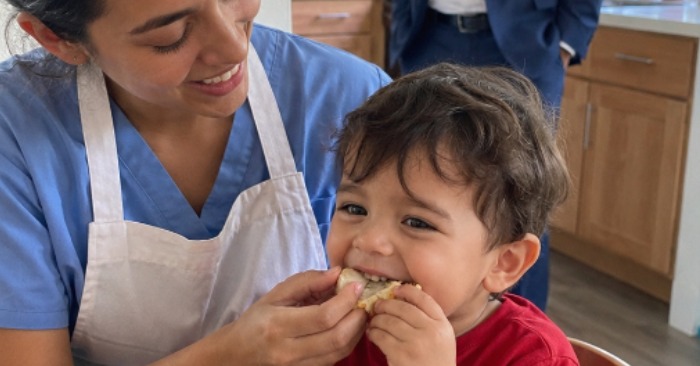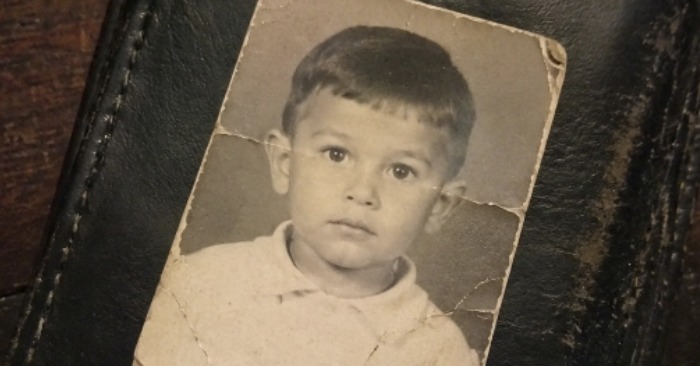
One year and a half old Owen Mercer refused every spoon, every bottle, every bite that was brought to his lips for seven long days.
He was only a toddler, yet the light inside him had dimmed so deeply that even the doctors began speaking in careful, measured voices whenever they entered the nursery. He no longer cried the way healthy children cry. He didn’t push food away in irritation, didn’t turn his head with playful stubbornness. He simply stared upward, quiet and distant, as if the world had already become too heavy for him.
His father, Grant Mercer, had built some of the most striking office towers in downtown Chicago. He was the kind of man whose calendar used to have no empty spaces, whose phone never stopped ringing, whose decisions moved money, concrete, and entire city blocks. But none of that mattered anymore.
That Thursday morning, before sunrise, Grant was on his knees beside Owen’s crib, still wearing the wrinkled shirt from the day before, his face carved by exhaustion.
“Please, buddy,” he whispered, holding out a small spoon of expensive purée that no child should have refused so many times. “Just one bite. That’s all I’m asking. One bite for me.”
Owen’s eyes stayed fixed on the ceiling.
The spoon trembled in Grant’s hand.
Around him were unopened jars of imported baby food, nutritional supplements recommended by specialists, and bottles arranged with desperate precision. Everything money could buy had already been brought into the house. Nothing had helped.
Across the room, the private nurse shifted quietly. She had been there for three nights already and had watched a father fall apart hour by hour.
“Mr. Mercer, you need to rest,” she said gently.
Grant let out a broken laugh that didn’t sound like laughter at all.
“How can I rest when my son is fading in front of me?”
He lowered the spoon and covered his face with one hand. The grief he had held back from the rest of the world seeped through that silence.
Three weeks earlier, his wife Mariel had died in an accident at one of his construction sites. Since that day, Owen had changed. The little boy who once clapped at sunlight dancing on the wall and squealed when his mother sang to him had become unnaturally still. First he stopped smiling. Then he began sleeping poorly. Then he stopped eating.
The doctors called it traumatic grief. Grant called it punishment.
In the deepest corner of his mind, he believed his son sensed a truth he could not escape himself: if he had not insisted that Mariel visit the site that day, she would still be alive.
A house full of wealth and silence
The Mercer home in Winnetka was large enough to impress anyone who stepped inside. Tall windows overlooked the lake. The floors shone like glass. The dining room could seat twelve without feeling crowded.
Yet the house no longer felt grand. It felt haunted by absence.
Everything was polished. Everything was expensive. Everything was unbearably quiet.
That same morning, while rain still clung to the sidewalks on the south side of the city, a twenty-eight-year-old cleaner named Elena Brooks stepped off a bus and adjusted the strap of her worn canvas bag.
She had agreed to fill in for another cleaner who was sick. A single day’s pay in a house like this would help with rent and food. Elena could not afford to refuse work.
She lived on the west side of the city in a small apartment with her younger brother and teenage cousin. Since losing her mother years ago, she had spent much of her life learning how to carry responsibility without complaint. She knew how to stretch meals, how to quiet her own hunger, how to comfort children when adults had no answers.
When the gates opened and she walked up the stone path to the Mercer home, she felt what she always felt in places like this: that she was invisible before anyone even looked at her.
The house manager, a strict woman named Mrs. Holloway, met her at the door and looked her up and down.
“You’re the replacement?” she asked.
“Yes, ma’am. Elena Brooks.”
“You’ll work only on the first floor. Keep noise to a minimum. Do not go upstairs unless instructed. Mr. Mercer’s son is unwell.”
Elena nodded.
“And do not involve yourself in family matters,” Mrs. Holloway added. “You are here to clean. Nothing more.”
Elena had heard versions of that sentence all her life.
“I understand,” she said.
But as she moved through the kitchen, the hallway, and the formal living room, she felt something she could not ignore. There was grief in the walls. Not the silence of peace, but the silence of people surviving minute by minute.
She noticed framed photographs. In the older ones, Grant and Mariel laughed on beaches, rooftops, in hospital rooms holding a newborn wrapped in a blue blanket. In the newer ones, Mariel was gone.
By noon, Elena had not seen the child, but she had heard him.
Not a normal cry. Not the impatient wail of a toddler wanting attention. It was thinner than that, more fragile, as if even sorrow had exhausted him.
Elena paused with a cleaning cloth in her hand and looked up toward the ceiling.
“Poor baby,” she murmured.
The child in the high chair
Staff meals took place in a narrow back room near the service entrance, far from the marble counters and custom cabinetry of the main kitchen.
Elena sat with her simple lunch in a plastic container and glanced through the slightly open door.
In the kitchen, Mrs. Holloway was trying to feed the child again.
Owen sat in a high chair, smaller than Elena had imagined. His cheeks had softened in that wrong way children’s faces soften when they have not eaten enough. He did not throw the spoon, did not pout, did not resist. He only turned his face away with such devastating emptiness that Elena stopped chewing.
“Come on, sweetheart,” Mrs. Holloway said, struggling to stay patient. “This is what the dietician recommended.”
Nothing.
The cook tried next. Then the nurse. Then another carefully prepared portion was set aside, untouched.
Elena had seen children refuse food before. But this was different. He wasn’t being difficult. He looked like a little boy waiting for someone who was not coming back.
“He’s been like this all week,” the cook said quietly.
“Ever since his mother passed,” Mrs. Holloway sighed, “he hasn’t been himself.”
Elena looked at Owen again. His eyes drifted toward the door, as if listening for footsteps he remembered better than words.
Something in Elena’s chest tightened.
Her own mother had died when she was twelve. No one had explained grief in a way a child could understand. They had simply expected life to continue. But children know when love leaves a room. They know it before adults admit it.
She finished her lunch, washed her container, and tried to return to work.
But she could not forget the small boy in the chair.
The only thing no specialist tried
Later in the afternoon, voices rose again in the kitchen.
Another feeding had failed.
Elena stood in the hallway, gripping her cleaning cloth, hearing frustration and fear in every adult voice around the child. The food was organic, balanced, approved, measured. But it was also lifeless.
Before she could talk herself out of it, she stepped into the doorway.
“Excuse me,” she said.
Mrs. Holloway turned sharply. “What are you doing here?”
Elena swallowed. “I know it’s not my place, but can I try something?”
The house manager looked at her as if she had suggested something absurd.
“Specialists have been trying all week.”
“I know,” Elena said softly. “Maybe that’s why I’m asking.”
The cook glanced between them.
“Let her,” she murmured.
Elena moved slowly to the counter and looked around. In a basket was fresh bread. By the stove, olive oil. Sea salt in a ceramic jar.
She took a slice of warm bread, tore off a small piece, and drizzled just a little olive oil over it. Then she added the lightest pinch of salt.
Mrs. Holloway nearly choked.
“You are not giving that child bread off the counter.”
Elena kept her voice steady.
“When I was little and too sad to eat, my grandmother didn’t come to me with pressure. She came with something simple and warm. Something that smelled like home.”
As she lifted the bread, the scent spread through the room.
And for the first time, Owen moved.
It wasn’t much. Just a turn of the head.
But every adult saw it.
The boy’s eyes, previously dull and empty, shifted toward Elena’s hand.
The cook gasped. The nurse covered her mouth.
Elena stepped closer, slow enough not to break the fragile thread forming between the child and the world.
“Hello, sweetheart,” she whispered. “You don’t have to do anything fast. Just smell it.”
Owen stared at the bread.
Then, with uncertain little fingers, he reached.
No one in the kitchen breathed.
He took the piece from her hand and held it for a moment, as if remembering what food was. Then he brought it to his mouth.
One bite.
A pause.
A second small chew.
And then, almost impossibly, he reached again.
The father at the doorway
That was when Grant Mercer entered the kitchen.
He had come down from his office after hearing noise, fully prepared for another update that would end in helplessness. Instead, he froze at the doorway.
His son was eating.
Not much. Not quickly. But eating.
Owen held a small piece of bread in his fist, olive oil shining on his lower lip.
Grant’s expression shifted so completely Elena would remember it for years: shock, hope, fear of hope, and then love—raw and trembling.
“Owen?” he said.
The little boy looked up.
For a suspended moment, father and son simply stared at each other.
Then Owen lifted his free hand slightly and made a small sound.
“Ta…”
Grant dropped to his knees.
He had not heard that voice in days.
“I’m here,” he whispered, tears already falling. “I’m here, buddy.”
He moved carefully, like someone approaching something sacred and fragile.
“What is he eating?” Grant asked, though the answer barely mattered.
Mrs. Holloway replied weakly, “Bread with olive oil and salt.”
Grant looked at Elena.
She stood there in a simple work uniform, hands rough from labor, eyes uncertain now that he was in the room.
“You did this?” he asked.
Elena lowered her gaze. “I just tried something simple.”
Grant looked back at his son, who was reaching for another piece.
“Then simple is the first thing that worked.”
His voice broke on the last word.
Elena prepared another small piece and waited for his nod before offering it. This time Owen accepted it more easily. The room, which had felt like failure for a week, began to feel like the beginning of something.
What the child actually needed
Grant stayed in the kitchen for the rest of the afternoon.
He held Owen after the first bites, and for the first time since Mariel’s death, the child did not stiffen in his arms. Instead, Owen rested his head against his father’s chest, as if he had been waiting for exactly this quiet.
Later, when the kitchen had calmed, Grant asked Elena to sit for a moment.
She hesitated. Men like him did not usually ask women like her to sit at their table.
But he insisted.
“Please.”
So Elena sat across from him while Owen slept on his shoulder.
“How did you know?” Grant asked.
Elena answered honestly.
“I didn’t know for sure. But I knew what I was seeing. Everyone was trying to fix his body. No one was feeding his heart.”
Grant looked down at his son.
Elena continued, softly but firmly.
“He doesn’t just need food. He needs to feel that life is still safe. He needs warmth. He needs calm. And he needs you—without all the fear you’re pouring into him.”
Grant swallowed hard.
“I’m failing him.”
“No,” Elena said. “You’re grieving him and his mother at the same time he is grieving. That’s not failure. But children taste what we bring into the room. If every meal comes wrapped in panic, they taste the panic first.”
He sat with that in silence.
No doctor had ever explained it like that.
No consultant had spoken so plainly.
Finally, he asked, “Would you stay? Not just today. Here. Help me take care of him. Help me learn how to do this right.”
Elena looked at Owen, then back at Grant.
She had come that morning hoping to earn enough for groceries.
She had not expected to be asked into the heart of a broken family.
“I’ll stay,” she said. “But only if you promise me something.”
“Anything.”
“Eat with him. Sit with him. Let him see his father still here, still living, still choosing him every day.”
Grant nodded immediately.
“I promise.”
Learning to be a family again
The following week changed the rhythm of the Mercer home.
Meetings were canceled. The formal dining room remained unused. Meals began happening at the kitchen table, where the light was warmer and the room felt less like a museum.
Elena showed Grant how to slow down. How to wait before offering another bite. How to smile even when terrified. How to narrate small moments so Owen could feel the comfort of ordinary life.
“Here comes Daddy’s bite.”
“Now Owen’s turn.”
“Look at us, eating together.”
Some mornings Owen ate very little. Some afternoons he surprised them and reached for more. Progress was uneven, but real.
Grant changed too.
He put his phone on the counter during meals. He learned to warm bread properly. He burned two batches before getting it right. He started bathing his son again. He sat on the nursery floor reading picture books in a voice that grew steadier over time.
One night, as he tucked Owen into bed, the boy touched his cheek and said, “Daddy stay?”
Grant nearly broke.
Instead, he kissed his forehead.
“Always,” he said.
Elena heard it from the doorway and quietly looked away, giving him dignity.
The kitchen became the heart of the home
Three months later, visitors noticed something impossible to ignore.
The house was alive again.
Toys lay in corners where design magazines once sat untouched. Finger paintings hung near the fridge. The kitchen table had become the center of everything.
Owen, stronger now and round-cheeked again, laughed often. He had favorite words, favorite spoons, favorite meals. He asked for bread in a voice that made everyone smile.
And every Sunday morning, he helped his father make it.
Flour dusted Grant’s sleeves. Owen stood on a small safe stool, patting dough with serious concentration while Elena watched with a dish towel over her shoulder.
“Gentle hands,” she reminded him.
“Gentle hands,” Owen repeated.
One bright morning, after placing an extra plate on the table the way he sometimes used to for his mother, Owen looked at Elena and asked, “Are you family?”
The room froze.
Grant didn’t hesitate.
“Yes,” he said. “She is.”
Elena blinked quickly and turned toward the counter, pretending to focus on the bread.
Owen seemed satisfied and reached for her hand with his flour-dusted fingers.
Grant watched them and understood something he had once been too proud and too distracted to learn: love does not always arrive dressed in importance. Sometimes it enters through the service door before sunrise, carrying a worn canvas bag and enough gentleness to bring a child back to life.
Sometimes the deepest healing does not begin with a dramatic miracle, but with a quiet act that tells a broken heart it is still safe to stay in this world.
A child may not have words for grief, confusion, or fear, but that does not make those feelings small, because small hearts often carry pain with a weight adults do not notice until it becomes silence.
Money can buy the best care, the best specialists, and every comfort delivered to the doorstep, but none of it can replace presence, patience, and the quiet love that makes someone feel less alone.
Parents do not need to be perfect to save their children; they only need the courage to stay close, keep showing up, and love through their own brokenness until trust begins to grow again.
Grief becomes heavier when wrapped in guilt, but healing begins the moment a person chooses to stop drowning in blame and start reaching for the living people who still need them.
The strongest people are not always the loudest, the richest, or the most admired, because sometimes true strength belongs to the one who notices suffering, steps forward with compassion, and chooses to care when others stay confined to their roles.
A home is not made warm by marble floors, expensive furniture, or beautiful walls, but by shared meals, honest tears, forgiving hearts, and the kind of laughter that returns when people decide not to give up on each other.
Children learn love less from adult explanations and more from what they feel, which is why a calm voice, a patient touch, and steady presence often teach more than a hundred perfect explanations ever could.
There are moments in life when simplicity becomes sacred, because a piece of bread offered with tenderness can carry more comfort and hope than all the complex solutions that never learned how to be human.
Families are not built only by blood or by plans made when life is easy, because sometimes they are rebuilt in grief, strengthened by kindness, and held together by those who choose to stay when leaving would be easier.One year and a half old Owen Mercer refused every spoon, every bottle, every bite that was brought to his lips for seven long days.
He was only a toddler, yet the light inside him had dimmed so deeply that even the doctors began speaking in careful, measured voices whenever they entered the nursery. He no longer cried the way healthy children cry. He didn’t push food away in irritation, didn’t turn his head with playful stubbornness. He simply stared upward, quiet and distant, as if the world had already become too heavy for him.
His father, Grant Mercer, had built some of the most striking office towers in downtown Chicago. He was the kind of man whose calendar used to have no empty spaces, whose phone never stopped ringing, whose decisions moved money, concrete, and entire city blocks. But none of that mattered anymore.
That Thursday morning, before sunrise, Grant was on his knees beside Owen’s crib, still wearing the wrinkled shirt from the day before, his face carved by exhaustion.
“Please, buddy,” he whispered, holding out a small spoon of expensive purée that no child should have refused so many times. “Just one bite. That’s all I’m asking. One bite for me.”
Owen’s eyes stayed fixed on the ceiling.
The spoon trembled in Grant’s hand.
Around him were unopened jars of imported baby food, nutritional supplements recommended by specialists, and bottles arranged with desperate precision. Everything money could buy had already been brought into the house. Nothing had helped.
Across the room, the private nurse shifted quietly. She had been there for three nights already and had watched a father fall apart hour by hour.
“Mr. Mercer, you need to rest,” she said gently.
Grant let out a broken laugh that didn’t sound like laughter at all.
“How can I rest when my son is fading in front of me?”
He lowered the spoon and covered his face with one hand. The grief he had held back from the rest of the world seeped through that silence.
Three weeks earlier, his wife Mariel had died in an accident at one of his construction sites. Since that day, Owen had changed. The little boy who once clapped at sunlight dancing on the wall and squealed when his mother sang to him had become unnaturally still. First he stopped smiling. Then he began sleeping poorly. Then he stopped eating.
The doctors called it traumatic grief. Grant called it punishment.
In the deepest corner of his mind, he believed his son sensed a truth he could not escape himself: if he had not insisted that Mariel visit the site that day, she would still be alive.
A house full of wealth and silence
The Mercer home in Winnetka was large enough to impress anyone who stepped inside. Tall windows overlooked the lake. The floors shone like glass. The dining room could seat twelve without feeling crowded.
Yet the house no longer felt grand. It felt haunted by absence.
Everything was polished. Everything was expensive. Everything was unbearably quiet.
That same morning, while rain still clung to the sidewalks on the south side of the city, a twenty-eight-year-old cleaner named Elena Brooks stepped off a bus and adjusted the strap of her worn canvas bag.
She had agreed to fill in for another cleaner who was sick. A single day’s pay in a house like this would help with rent and food. Elena could not afford to refuse work.
She lived on the west side of the city in a small apartment with her younger brother and teenage cousin. Since losing her mother years ago, she had spent much of her life learning how to carry responsibility without complaint. She knew how to stretch meals, how to quiet her own hunger, how to comfort children when adults had no answers.
When the gates opened and she walked up the stone path to the Mercer home, she felt what she always felt in places like this: that she was invisible before anyone even looked at her.
The house manager, a strict woman named Mrs. Holloway, met her at the door and looked her up and down.
“You’re the replacement?” she asked.
“Yes, ma’am. Elena Brooks.”
“You’ll work only on the first floor. Keep noise to a minimum. Do not go upstairs unless instructed. Mr. Mercer’s son is unwell.”
Elena nodded.
“And do not involve yourself in family matters,” Mrs. Holloway added. “You are here to clean. Nothing more.”
Elena had heard versions of that sentence all her life.
“I understand,” she said.
But as she moved through the kitchen, the hallway, and the formal living room, she felt something she could not ignore. There was grief in the walls. Not the silence of peace, but the silence of people surviving minute by minute.
She noticed framed photographs. In the older ones, Grant and Mariel laughed on beaches, rooftops, in hospital rooms holding a newborn wrapped in a blue blanket. In the newer ones, Mariel was gone.
By noon, Elena had not seen the child, but she had heard him.
Not a normal cry. Not the impatient wail of a toddler wanting attention. It was thinner than that, more fragile, as if even sorrow had exhausted him.
Elena paused with a cleaning cloth in her hand and looked up toward the ceiling.
“Poor baby,” she murmured.
The child in the high chair
Staff meals took place in a narrow back room near the service entrance, far from the marble counters and custom cabinetry of the main kitchen.
Elena sat with her simple lunch in a plastic container and glanced through the slightly open door.
In the kitchen, Mrs. Holloway was trying to feed the child again.
Owen sat in a high chair, smaller than Elena had imagined. His cheeks had softened in that wrong way children’s faces soften when they have not eaten enough. He did not throw the spoon, did not pout, did not resist. He only turned his face away with such devastating emptiness that Elena stopped chewing.
“Come on, sweetheart,” Mrs. Holloway said, struggling to stay patient. “This is what the dietician recommended.”
Nothing.
The cook tried next. Then the nurse. Then another carefully prepared portion was set aside, untouched.
Elena had seen children refuse food before. But this was different. He wasn’t being difficult. He looked like a little boy waiting for someone who was not coming back.
“He’s been like this all week,” the cook said quietly.
“Ever since his mother passed,” Mrs. Holloway sighed, “he hasn’t been himself.”
Elena looked at Owen again. His eyes drifted toward the door, as if listening for footsteps he remembered better than words.
Something in Elena’s chest tightened.
Her own mother had died when she was twelve. No one had explained grief in a way a child could understand. They had simply expected life to continue. But children know when love leaves a room. They know it before adults admit it.
She finished her lunch, washed her container, and tried to return to work.
But she could not forget the small boy in the chair.
The only thing no specialist tried
Later in the afternoon, voices rose again in the kitchen.
Another feeding had failed.
Elena stood in the hallway, gripping her cleaning cloth, hearing frustration and fear in every adult voice around the child. The food was organic, balanced, approved, measured. But it was also lifeless.
Before she could talk herself out of it, she stepped into the doorway.
“Excuse me,” she said.
Mrs. Holloway turned sharply. “What are you doing here?”
Elena swallowed. “I know it’s not my place, but can I try something?”
The house manager looked at her as if she had suggested something absurd.
“Specialists have been trying all week.”
“I know,” Elena said softly. “Maybe that’s why I’m asking.”
The cook glanced between them.
“Let her,” she murmured.
Elena moved slowly to the counter and looked around. In a basket was fresh bread. By the stove, olive oil. Sea salt in a ceramic jar.
She took a slice of warm bread, tore off a small piece, and drizzled just a little olive oil over it. Then she added the lightest pinch of salt.
Mrs. Holloway nearly choked.
“You are not giving that child bread off the counter.”
Elena kept her voice steady.
“When I was little and too sad to eat, my grandmother didn’t come to me with pressure. She came with something simple and warm. Something that smelled like home.”
As she lifted the bread, the scent spread through the room.
And for the first time, Owen moved.
It wasn’t much. Just a turn of the head.
But every adult saw it.
The boy’s eyes, previously dull and empty, shifted toward Elena’s hand.
The cook gasped. The nurse covered her mouth.
Elena stepped closer, slow enough not to break the fragile thread forming between the child and the world.
“Hello, sweetheart,” she whispered. “You don’t have to do anything fast. Just smell it.”
Owen stared at the bread.
Then, with uncertain little fingers, he reached.
No one in the kitchen breathed.
He took the piece from her hand and held it for a moment, as if remembering what food was. Then he brought it to his mouth.
One bite.
A pause.
A second small chew.
And then, almost impossibly, he reached again.
The father at the doorway
That was when Grant Mercer entered the kitchen.
He had come down from his office after hearing noise, fully prepared for another update that would end in helplessness. Instead, he froze at the doorway.
His son was eating.
Not much. Not quickly. But eating.
Owen held a small piece of bread in his fist, olive oil shining on his lower lip.
Grant’s expression shifted so completely Elena would remember it for years: shock, hope, fear of hope, and then love—raw and trembling.
“Owen?” he said.
The little boy looked up.
For a suspended moment, father and son simply stared at each other.
Then Owen lifted his free hand slightly and made a small sound.
“Ta…”
Grant dropped to his knees.
He had not heard that voice in days.
“I’m here,” he whispered, tears already falling. “I’m here, buddy.”
He moved carefully, like someone approaching something sacred and fragile.
“What is he eating?” Grant asked, though the answer barely mattered.
Mrs. Holloway replied weakly, “Bread with olive oil and salt.”
Grant looked at Elena.
She stood there in a simple work uniform, hands rough from labor, eyes uncertain now that he was in the room.
“You did this?” he asked.
Elena lowered her gaze. “I just tried something simple.”
Grant looked back at his son, who was reaching for another piece.
“Then simple is the first thing that worked.”
His voice broke on the last word.
Elena prepared another small piece and waited for his nod before offering it. This time Owen accepted it more easily. The room, which had felt like failure for a week, began to feel like the beginning of something.
What the child actually needed
Grant stayed in the kitchen for the rest of the afternoon.
He held Owen after the first bites, and for the first time since Mariel’s death, the child did not stiffen in his arms. Instead, Owen rested his head against his father’s chest, as if he had been waiting for exactly this quiet.
Later, when the kitchen had calmed, Grant asked Elena to sit for a moment.
She hesitated. Men like him did not usually ask women like her to sit at their table.
But he insisted.
“Please.”
So Elena sat across from him while Owen slept on his shoulder.
“How did you know?” Grant asked.
Elena answered honestly.
“I didn’t know for sure. But I knew what I was seeing. Everyone was trying to fix his body. No one was feeding his heart.”
Grant looked down at his son.
Elena continued, softly but firmly.
“He doesn’t just need food. He needs to feel that life is still safe. He needs warmth. He needs calm. And he needs you—without all the fear you’re pouring into him.”
Grant swallowed hard.
“I’m failing him.”
“No,” Elena said. “You’re grieving him and his mother at the same time he is grieving. That’s not failure. But children taste what we bring into the room. If every meal comes wrapped in panic, they taste the panic first.”
He sat with that in silence.
No doctor had ever explained it like that.
No consultant had spoken so plainly.
Finally, he asked, “Would you stay? Not just today. Here. Help me take care of him. Help me learn how to do this right.”
Elena looked at Owen, then back at Grant.
She had come that morning hoping to earn enough for groceries.
She had not expected to be asked into the heart of a broken family.
“I’ll stay,” she said. “But only if you promise me something.”
“Anything.”
“Eat with him. Sit with him. Let him see his father still here, still living, still choosing him every day.”
Grant nodded immediately.
“I promise.”
Learning to be a family again
The following week changed the rhythm of the Mercer home.
Meetings were canceled. The formal dining room remained unused. Meals began happening at the kitchen table, where the light was warmer and the room felt less like a museum.
Elena showed Grant how to slow down. How to wait before offering another bite. How to smile even when terrified. How to narrate small moments so Owen could feel the comfort of ordinary life.
“Here comes Daddy’s bite.”
“Now Owen’s turn.”
“Look at us, eating together.”
Some mornings Owen ate very little. Some afternoons he surprised them and reached for more. Progress was uneven, but real.
Grant changed too.
He put his phone on the counter during meals. He learned to warm bread properly. He burned two batches before getting it right. He started bathing his son again. He sat on the nursery floor reading picture books in a voice that grew steadier over time.
One night, as he tucked Owen into bed, the boy touched his cheek and said, “Daddy stay?”
Grant nearly broke.
Instead, he kissed his forehead.
“Always,” he said.
Elena heard it from the doorway and quietly looked away, giving him dignity.
The kitchen became the heart of the home
Three months later, visitors noticed something impossible to ignore.
The house was alive again.
Toys lay in corners where design magazines once sat untouched. Finger paintings hung near the fridge. The kitchen table had become the center of everything.
Owen, stronger now and round-cheeked again, laughed often. He had favorite words, favorite spoons, favorite meals. He asked for bread in a voice that made everyone smile.
And every Sunday morning, he helped his father make it.
Flour dusted Grant’s sleeves. Owen stood on a small safe stool, patting dough with serious concentration while Elena watched with a dish towel over her shoulder.
“Gentle hands,” she reminded him.
“Gentle hands,” Owen repeated.
One bright morning, after placing an extra plate on the table the way he sometimes used to for his mother, Owen looked at Elena and asked, “Are you family?”
The room froze.
Grant didn’t hesitate.
“Yes,” he said. “She is.”
Elena blinked quickly and turned toward the counter, pretending to focus on the bread.
Owen seemed satisfied and reached for her hand with his flour-dusted fingers.
Grant watched them and understood something he had once been too proud and too distracted to learn: love does not always arrive dressed in importance. Sometimes it enters through the service door before sunrise, carrying a worn canvas bag and enough gentleness to bring a child back to life.
Sometimes the deepest healing does not begin with a dramatic miracle, but with a quiet act that tells a broken heart it is still safe to stay in this world.
A child may not have words for grief, confusion, or fear, but that does not make those feelings small, because small hearts often carry pain with a weight adults do not notice until it becomes silence.
Money can buy the best care, the best specialists, and every comfort delivered to the doorstep, but none of it can replace presence, patience, and the quiet love that makes someone feel less alone.
Parents do not need to be perfect to save their children; they only need the courage to stay close, keep showing up, and love through their own brokenness until trust begins to grow again.
Grief becomes heavier when wrapped in guilt, but healing begins the moment a person chooses to stop drowning in blame and start reaching for the living people who still need them.
The strongest people are not always the loudest, the richest, or the most admired, because sometimes true strength belongs to the one who notices suffering, steps forward with compassion, and chooses to care when others stay confined to their roles.
A home is not made warm by marble floors, expensive furniture, or beautiful walls, but by shared meals, honest tears, forgiving hearts, and the kind of laughter that returns when people decide not to give up on each other.
Children learn love less from adult explanations and more from what they feel, which is why a calm voice, a patient touch, and steady presence often teach more than a hundred perfect explanations ever could.
There are moments in life when simplicity becomes sacred, because a piece of bread offered with tenderness can carry more comfort and hope than all the complex solutions that never learned how to be human.
Families are not built only by blood or by plans made when life is easy, because sometimes they are rebuilt in grief, strengthened by kindness, and held together by those who choose to stay when leaving would be easier.
Egy összetört milliomos nem tudta megmenteni a fiát — amíg egy takarítónő nem adott neki kenyeret